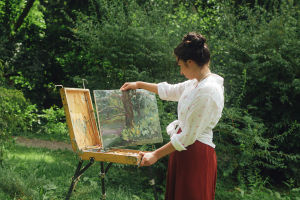
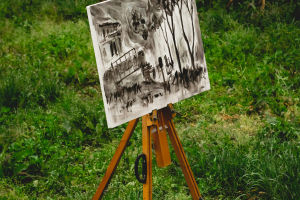
Naive art occupies a distinctive place in visual culture because it emerges outside formal artistic training.
Unlike academic painting traditions shaped by perspective theory, anatomy studies, and technical constraints, naive art is created by individuals who often develop their own visual logic.
This does not mean the work is simplistic; instead, it follows an independent structure where proportion, depth, and color operate according to personal perception rather than institutional standards.
Art historians often associate naive art with self-taught creators such as Henri Rousseau, whose jungle scenes were painted without formal education yet displayed a highly recognizable style. The appeal of this tradition lies in its directness—images are constructed without the filtering effect of academic correction, producing compositions that feel immediate and emotionally transparent.
Perspective That Rejects Optical Precision
One of the most defining features of naive art is its unconventional treatment of space. Instead of adhering to linear perspective, objects are often arranged in flattened or stacked arrangements. Buildings may appear tilted, figures can be oversized relative to their surroundings, and spatial depth is suggested through repetition or color contrast rather than vanishing points.
This approach is not an error but a different way of representing reality. In many cases, naive artists prioritize narrative clarity over optical accuracy. A village scene, for example, may display every house equally visible, as if the entire environment is unfolding simultaneously. This method creates a sense of visual honesty rooted in memory rather than measurement.
Color as Emotional Structure
Color in naive art is rarely restrained by naturalistic expectations. Skies may be saturated blue regardless of weather, trees can appear in intense greens or unexpected reds, and interiors often glow with exaggerated warmth. These choices are not arbitrary; they reflect emotional or symbolic intent rather than observational realism.
Psychological studies of visual perception suggest that color plays a central role in memory reconstruction. Naive artists frequently rely on remembered impressions instead of direct observation, leading to palettes that emphasize mood over accuracy. This gives the works a vivid, almost dreamlike quality, where emotional resonance replaces optical fidelity.
Narrative Density and Everyday Life
Naive art often focuses on ordinary scenes—markets, rural landscapes, festivals, domestic interiors—yet these subjects are depicted with extraordinary narrative density. Multiple events can occur within a single canvas, without strict separation of time or space. This storytelling approach reflects a non-linear understanding of experience, where moments are layered rather than sequential.
Artists such as Grandma Moses in the United States became widely recognized for depicting rural American life with this narrative richness. Her paintings compress seasonal cycles, labor routines, and communal gatherings into unified visual fields, offering a cultural record shaped by lived experience rather than academic interpretation.
Cultural Roots and Regional Identity
Naive art is deeply connected to local environments and cultural memory. Because many creators work outside institutional art centers, their imagery often reflects regional architecture, traditional clothing, and community rituals with remarkable specificity. This makes naive art an important visual archive of cultural identity, particularly in societies where formal documentation may be limited.
In Eastern Europe, for example, naive painting has been associated with rural traditions and folk storytelling, while in Latin America it often reflects vibrant urban and village life infused with symbolic detail. These regional variations demonstrate that naive art is not a single style but a global phenomenon shaped by local experience.
Psychological Directness and Viewer Connection
The emotional strength of naive art lies in its lack of visual mediation. Because it avoids complex abstraction or technical illusionism, viewers often experience a direct connection with the subject matter. Faces are expressive without being anatomically precise, and environments feel familiar even when structurally unconventional.
This immediacy is one reason naive art has been embraced by modern museums and collectors. Institutions such as the Musée d’Art Naïf in Paris have highlighted its cultural value, recognizing that its power does not depend on academic technique but on its ability to communicate experience in an unfiltered form.
Position in Modern and Contemporary Art
While naive art originated outside formal movements, it has influenced modern artistic discourse in subtle ways. Early 20th-century avant-garde artists admired its freedom from academic constraints, seeing it as a reminder that artistic expression does not require institutional validation. Elements of naive aesthetics can be traced in modern primitivism, expressionism, and certain strands of contemporary outsider art.
However, naive art remains distinct because it is not defined by rebellion against tradition. Instead, it exists independently of it, shaped by creators who often develop their style without reference to art history at all.
The charm of naive art lies in its ability to transform ordinary perception into visual storytelling without the constraints of formal technique. It reveals how deeply personal interpretation can shape the representation of the world, producing images that feel both imaginative and grounded in lived reality. By refusing to conform to academic standards, it opens a space where memory, emotion, and cultural identity become the true structure of the image.
In a visual world often dominated by precision and digital perfection, naive art reminds us that meaning can emerge from imperfection—and that sometimes the most honest vision is the one that follows no rules except the artist’s own way of seeing, leaving us to wonder what other truths might exist beyond the boundaries of trained eyes.